
If you’re planning joinery work in your home, one of the first questions is usually straightforward: how much does a joiner cost?
Unfortunately, there isn’t one equally straightforward answer.
Joinery covers everything from hanging a single internal door to manufacturing bespoke fitted furniture, renovating a staircase or completing the timber structure of an extension. Two projects that take up a similar amount of space can require completely different levels of skill, materials and time.
For professional joinery work in Leeds, you might encounter labour rates of approximately £300–£450+ per day, but day rates are not necessarily the best way to price a complete project.
For defined work, a fixed quotation is usually much more useful.
This guide explains what affects joinery prices, gives realistic examples of common projects and explains what to look for when comparing quotations.
What Does a Joiner Actually Do?
Joinery is an extremely broad trade.
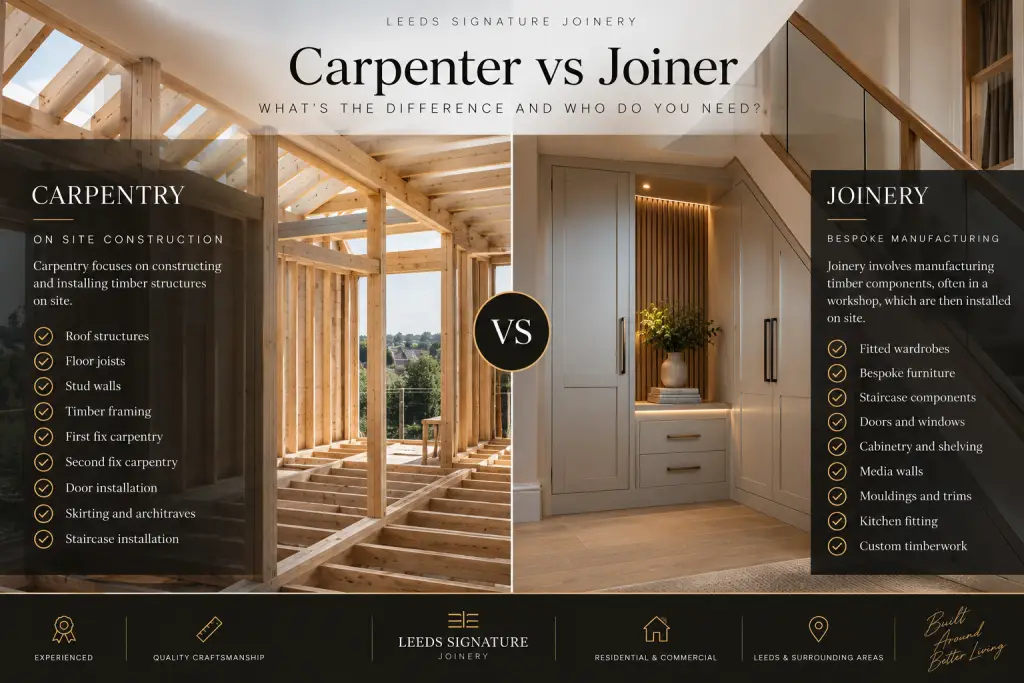
Depending on their experience and specialism, a joiner or carpenter may undertake work including:
- hanging internal doors
- fitting fire doors
- skirting and architraves
- staircase renovations
- handrails and balustrades
- fitted wardrobes
- under-stairs storage
- media walls
- kitchen fitting
- timber flooring
- stud walls
- floor joists
- roof structures
- first-fix carpentry
- second-fix joinery
- bespoke furniture
This is one reason comparing joinery prices purely by hourly or daily rate can be misleading.
The cheapest person per day is not necessarily the cheapest person to complete the project.
Typical Joiner Day Rates in Leeds
As a broad guide, professional joinery labour in Leeds might fall somewhere around:
£300–£450+ per day
depending on the type of work and the joiner’s experience.
Specialist bespoke work can effectively cost more because it may involve design, workshop manufacturing, specialist machinery and finishing in addition to the time physically spent at the property.
Smaller jobs may also be priced differently.
A job that takes two hours cannot always be calculated simply by dividing a day rate by four. Travel, loading tools, collecting materials, setting up and clearing the site still need to be accounted for.
Hourly Rate vs Day Rate vs Fixed Price
There are three common ways joinery work can be priced.
Hourly Rate
Hourly pricing can make sense for small repairs or work where the scope is difficult to establish beforehand.
However, it gives the customer less certainty over the final cost.
Day Rate
Day rates are useful where a joiner is providing labour for an ongoing project.
They are common in construction environments where the work is being coordinated by somebody else.
For homeowners commissioning a defined project, however, a day rate does not necessarily tell you what the completed job will cost.
Fixed Quotation
For most clearly defined residential projects, we prefer a fixed quotation based on an agreed scope of work.
That means we assess what is required and price the project rather than simply selling blocks of time.
If the scope subsequently changes, any variation can then be discussed separately.
How Much Does It Cost to Hang an Internal Door?
Door installation sounds straightforward, but there can be considerable variation between jobs.
As a broad guide, fitting a standard internal door might cost approximately:
£150–£180+ per door for labour
depending on the existing opening, door type and ironmongery.
The cost can increase where:
- existing linings require adjustment
- the opening is significantly out of square
- specialist hinges are required
- expensive ironmongery needs fitting
- substantial trimming is necessary
- the door is unusually heavy
- existing doors and hardware need removing
Multiple doors completed during the same visit can also be more economical than fitting a single door.
How Much Does Fire Door Installation Cost?
Fire doors require additional consideration because they form part of a fire-resisting assembly rather than simply functioning as ordinary internal doors.
Installation costs vary considerably depending on whether the project involves fitting a door into a suitable existing frame or replacing the complete doorset arrangement.
As a rough guide, labour for straightforward fire door installation might start around:
£150–£250+ per door
but this should not be treated as a universal rate.
The specification may require suitable hinges, closers, intumescent products, smoke seals and other compatible components.
Existing frames and openings also need to be assessed.
A fire door should never be treated as an ordinary door with a few additional accessories fitted to it.
How Much Does Skirting Board Installation Cost?
Skirting is commonly priced by linear metre or as part of a larger second-fix package.
As a rough labour guide:
£8–£12+ per linear metre
may be appropriate for straightforward installations.
However, the price can increase with:
- tall or detailed profiles
- hardwood skirting
- irregular walls
- numerous corners
- scribing requirements
- difficult existing finishes
- small fragmented areas
A large empty room is substantially quicker to work around than multiple small rooms containing awkward junctions.
How Much Does Architrave Installation Cost?
Architraves are commonly installed alongside door linings and doors.
Labour might typically fall around:
£70–£90+ per doorway
depending on the profile, material and condition of the opening.
Again, this is only a guide.
Bespoke hardwood mouldings or complex detailing can require considerably more work than standard softwood profiles.
How Much Does a Staircase Renovation Cost?
Staircase work varies enormously.
Replacing a handrail and spindles is fundamentally different from cladding an entire staircase in oak and installing bespoke glass balustrades.
As a broad guide:
- basic balustrade renovation: £1,500–£2,500+
- oak staircase/balustrade renovation: £2,500–£5,000+
- oak and glass renovation: £3,000–£6,000+
- extensive staircase transformation: £4,000–£8,000+
We cover this in considerably more detail in our guide to staircase renovation costs in Leeds.
How Much Do Fitted Wardrobes Cost?
Bespoke fitted furniture is normally priced as a complete project rather than by day.
A straightforward fitted wardrobe installation might start around:
£2,000–£3,000
while larger full-wall installations commonly fall around:
£3,000–£5,000+
Premium fitted furniture with extensive drawers, specialist hardware, detailed doors and high-quality finishes can exceed:
£5,000–£7,000+
Size is only one part of the calculation.
Internal complexity, material selection and finishing can have an equally significant effect on price.
Our guide to bespoke fitted wardrobe costs in Leeds explains these factors in more detail.
How Much Does Kitchen Fitting Cost?
Kitchen installation costs depend on the number of units and the complexity of the design.
A relatively straightforward kitchen installation might involve cabinets, panels, plinths, cornices, worktops and appliance integration.
Larger projects can involve considerably more joinery and coordination with other trades.
As a broad starting point, joinery labour for a typical kitchen installation might fall somewhere around:
£2,500–£4,500+
with larger, bespoke or more complicated kitchens costing considerably more.
Worktops, plumbing, electrical work, plastering, decorating and other trades may be priced separately depending on the project.
How Much Does Under-Stairs Storage Cost?
Under-stairs storage is a good example of why generic joinery rates can be misleading.
A simple cupboard beneath a staircase and a bespoke bank of pull-out drawers may occupy almost exactly the same area but require completely different levels of manufacturing and hardware.
A professionally made under-stairs installation might broadly start around:
£1,500–£2,500
with more detailed drawer and cupboard configurations commonly reaching:
£2,500–£5,000+
The design, finish and internal configuration determine much of the final cost.
What Makes Bespoke Joinery More Expensive?
With bespoke work, much of the labour happens before anything is installed in the property.
A project may involve:
- site survey
- design
- setting out
- material ordering
- workshop preparation
- machining
- assembly
- finishing
- transportation
- installation
- adjustment
- final detailing
Looking only at the installation time therefore gives an incomplete picture.
A fitted wardrobe that takes three days to install may have required substantially more time to design and manufacture beforehand.
Material Choice Matters
Materials can account for a significant proportion of the project cost.
There is a considerable difference between standard MDF and premium hardwood.
Common joinery materials include:
- MDF
- moisture-resistant MDF
- plywood
- decorative furniture board
- softwood
- oak
- other hardwoods
- veneered sheet materials
Hardware also matters.
Premium hinges, drawer runners, handles and specialist fittings can add hundreds of pounds to a large furniture project.
Why Oak Costs More
Oak is considerably more expensive than standard softwood or MDF, but the raw material price is only part of the difference.
Hardwood components often require careful selection and machining.
Grain direction, colour variation and timber movement also need to be considered.
When oak is intended to remain visible, the quality of the joinery and finishing becomes particularly important because imperfections cannot simply be filled and painted over.
Why Are Joinery Quotes So Different?
It is not unusual to receive dramatically different quotations for apparently the same project.
Sometimes one contractor is simply more expensive.
But often the quotations are not actually pricing the same thing.
Differences can include:
- material specification
- hardware quality
- finishing
- waste removal
- protection of the property
- design time
- workshop manufacturing
- number of site visits
- VAT
- whether other trades are included
- exactly what is being removed or retained
A £3,000 quotation and a £4,500 quotation cannot be compared properly until you know what each one includes.
Should You Choose the Cheapest Joinery Quote?
Not automatically.
Price should absolutely form part of the decision, but the cheapest quotation is only good value if the completed work meets the required standard.
For visible joinery in particular, relatively small details can have a major effect on the finished result.
Look at:
- previous work
- reviews
- clarity of quotation
- material specification
- communication
- proposed construction method
- finishing quality
- attention to detail
A vague one-line price is much harder to evaluate than a quotation that clearly explains what is included.
What Should a Joinery Quote Include?
For a defined project, you should be able to understand what you are actually purchasing.
Depending on the work, a quotation may identify:
- scope of work
- materials
- main components
- labour
- installation
- finishing
- exclusions
- payment terms
- VAT
- approximate programme
Not every screw needs to be individually listed, but the scope should be clear enough that both parties understand what the finished project is supposed to include.
Can You Save Money by Supplying Materials Yourself?
Sometimes, but it is worth discussing before ordering anything.
Client-supplied materials can work perfectly well when the specification has been agreed.
Problems arise when products arrive that are:
- the wrong size
- unsuitable for the application
- damaged
- incomplete
- incompatible with other components
This can delay the work and potentially create additional labour.
For specialist joinery, we generally prefer to establish the specification before materials are purchased.
Why Good Joinery Can Take Time
Speed matters on a construction project, but speed should not come at the expense of accuracy.
A difference of only a few millimetres can become very obvious across repeated doors, drawers, spindles or shadow gaps.
Good joinery involves setting out carefully before cutting.
That is particularly important with bespoke work because many components cannot simply be replaced from stock if something is manufactured incorrectly.
The objective is not to take longer than necessary.
It is to work efficiently without compromising precision.
Getting an Accurate Joinery Quote in Leeds
The quickest way to establish a realistic budget is to provide as much useful information as possible.
For an initial enquiry, this can include:
- photographs
- approximate dimensions
- description of the required work
- preferred materials
- inspiration images
- property location
- desired timescale
For straightforward work, that may be enough to provide an initial indication.
For bespoke or more complicated projects, a site survey is normally required before the final specification and quotation can be established.
Joinery and Carpentry in Leeds
At Leeds Signature Joinery, we undertake bespoke joinery and carpentry projects throughout Leeds and the surrounding areas.
With two decades of experience, our work ranges from doors and second-fix joinery through to bespoke fitted furniture, staircase renovations, kitchens and structural timber work.
Our approach is simple: establish exactly what the project requires, specify it properly and complete the work to a standard appropriate for the property.
If you’re planning a joinery project and would like an accurate quotation, contact Leeds Signature Joinery with photographs, approximate dimensions and a description of what you’re looking to achieve.