Choosing between fitted and freestanding wardrobes can have a surprisingly large impact on how a bedroom looks, feels and functions.
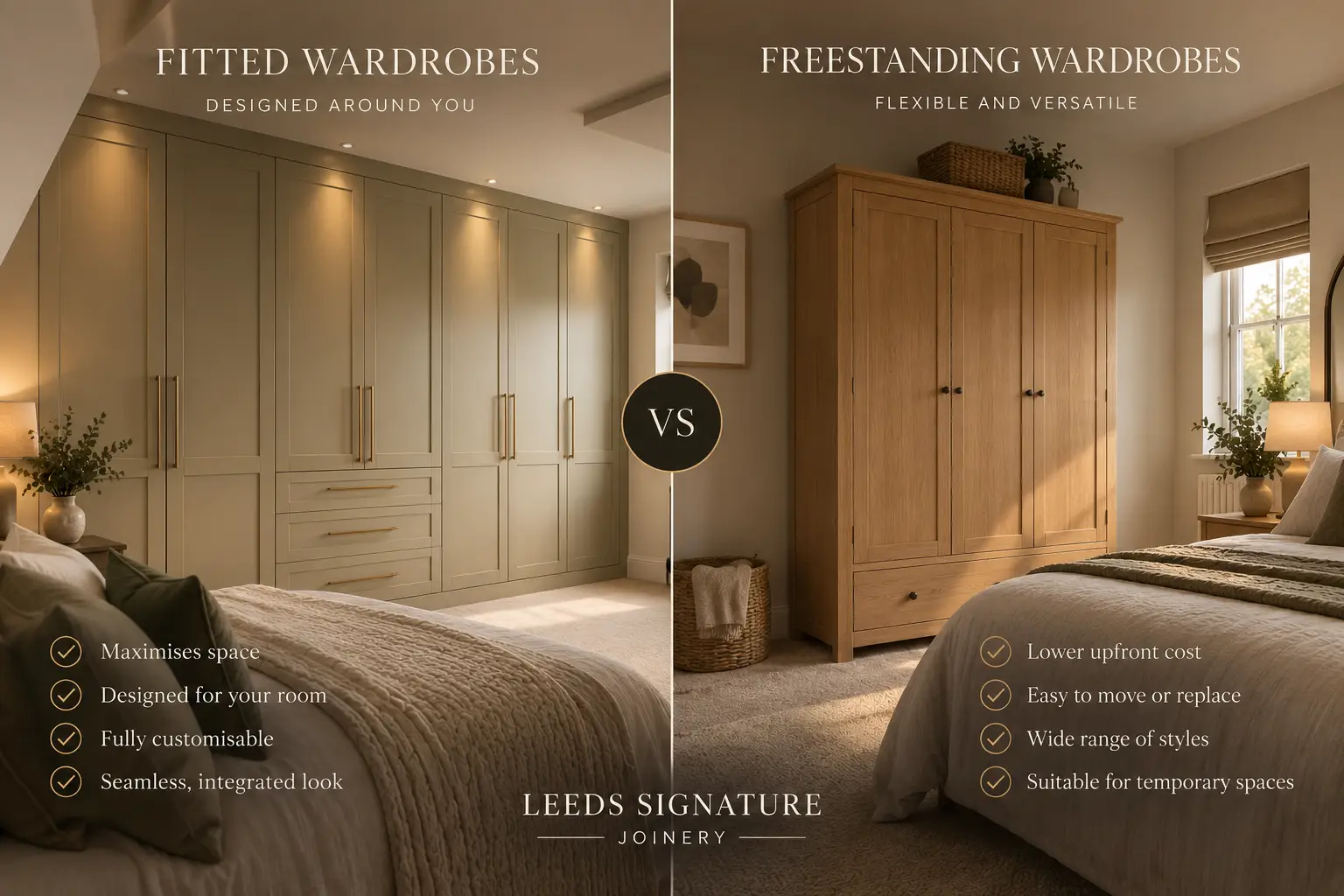
Freestanding wardrobes are readily available, relatively easy to replace and often cost considerably less upfront. Bespoke fitted wardrobes require a greater investment, but they can use space far more efficiently and become an integrated part of the room.
Neither option is automatically better.
The right choice depends on the property, available space, storage requirements, budget and how long you expect the furniture to remain in the room.
Here are the main differences to consider.
What Are Fitted Wardrobes?
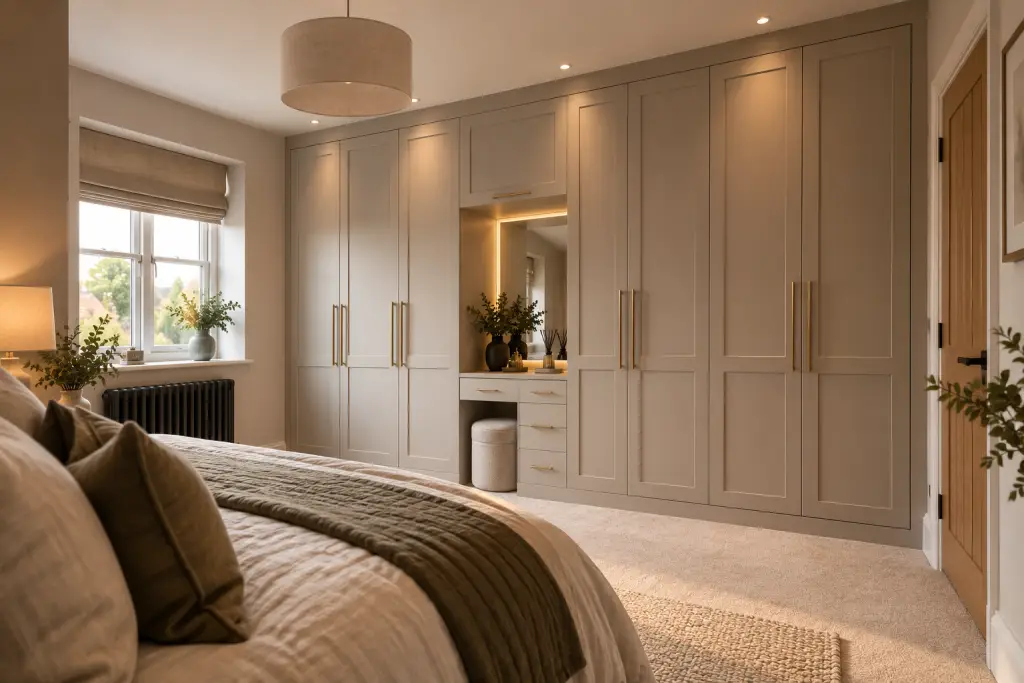
Fitted wardrobes are designed and installed specifically for a particular space.
Rather than selecting furniture from predetermined sizes, the cabinetry can be manufactured around the dimensions and features of the room.
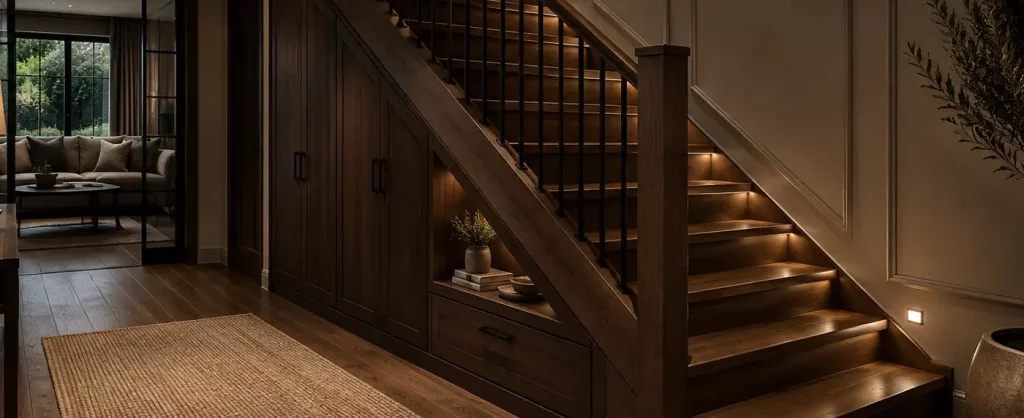
This allows wardrobes to work around:
- alcoves
- chimney breasts
- sloping ceilings
- uneven walls
- unusually high ceilings
- narrow spaces
- awkward corners
- existing architectural details
The internal configuration can also be designed around the person using it.
That might mean considerably more hanging space, additional drawers, dedicated shoe storage or high-level cupboards for items that are only occasionally needed.
What Are Freestanding Wardrobes?
Freestanding wardrobes are manufactured as complete pieces of furniture that can be positioned within a room.
They are available in an enormous range of styles, materials and price points.
Their biggest advantage is flexibility.
They can usually be moved around the room, taken to another property or replaced without altering the surrounding space.
For renters, temporary accommodation or rooms where storage requirements may change frequently, this can make perfect sense.
Which Uses Space More Efficiently?
This is where fitted wardrobes generally have the advantage.
A freestanding wardrobe has fixed dimensions.
If the available wall is 3.4 metres wide and the furniture occupies 2.8 metres, the remaining space may have little practical use.
There can also be substantial unused space above the wardrobe.
A fitted installation can instead be designed to use virtually the entire available area.
Cabinetry can extend from wall to wall and, where appropriate, from floor to ceiling.
In a smaller bedroom, that difference can be significant.
Floor-to-Ceiling Storage
Taking wardrobes close to the ceiling is one of the most effective ways to increase storage without consuming additional floor space.
High-level cupboards can be useful for:
- suitcases
- spare bedding
- seasonal clothing
- boxes
- infrequently used belongings
These are exactly the types of items that otherwise end up occupying valuable everyday storage.
Floor-to-ceiling cabinetry can also eliminate the difficult-to-clean space commonly found above freestanding wardrobes.
Which Looks Better?
This is subjective, because excellent examples exist in both categories.
A high-quality freestanding wardrobe can be a beautiful piece of furniture.
The principal visual advantage of fitted furniture is integration.
When properly designed, fitted wardrobes can appear to belong to the architecture of the room.
Scribes can follow the walls, cabinetry can meet the ceiling neatly, plinths can relate to existing skirting and the proportions can be designed around the room itself.
Instead of looking like furniture that has been placed against a wall, the wardrobes can feel like part of the room.
Bespoke Doesn’t Have to Mean Traditional
Fitted wardrobes are sometimes associated with traditional shaker-style cabinetry, but bespoke furniture can be designed in virtually any style.
A contemporary installation might use:
- flat slab doors
- handleless detailing
- shadow gaps
- wood-effect finishes
- integrated lighting
- minimal hardware
A more traditional design might incorporate:
- shaker doors
- decorative cornices
- painted finishes
- traditional handles
- detailed plinths
The advantage of bespoke manufacturing is that the design does not have to conform to a predetermined furniture range.
Which Is Better for Awkward Rooms?
Fitted furniture usually has a significant advantage here.
Some rooms simply do not suit standard furniture.
Loft bedrooms are a good example.
A sloping ceiling may make much of the perimeter unsuitable for conventional wardrobes, even though there is still enough space for useful storage.
Bespoke cabinetry can be manufactured to follow the slope and use those areas more effectively.
The same applies to alcoves and chimney breasts.
Rather than trying to find furniture that approximately fits the available opening, the furniture can be designed specifically for it.
Internal Storage: The Biggest Difference
The exterior gets most of the attention, but the internal layout is arguably more important.
A standard wardrobe normally provides a predetermined combination of hanging rails and shelves.
With bespoke wardrobes, we can start with what actually needs to be stored.
For example, someone with predominantly shirts and trousers may need considerably more double-height hanging space.
Someone with a large collection of dresses and coats will require more full-height hanging.
Another client might prioritise drawers, shoes or folded clothing.
There is little benefit in having beautifully made storage if half of the internal space does not suit how you actually use it.
Drawers Inside Fitted Wardrobes
Integrated drawers are particularly useful because they can reduce the need for separate bedroom furniture.
Instead of having wardrobes plus a freestanding chest of drawers, both functions can be incorporated into one installation.
That can free additional floor space elsewhere in the bedroom.
Drawer heights and widths can also be varied depending on what will be stored.
Good-quality runners are worth considering here. Drawers are used frequently, so hardware quality has a noticeable impact on how the furniture feels over time.
Which Is Cheaper?
Freestanding wardrobes will generally be cheaper.
Mass-manufactured furniture benefits from standardised designs, automated manufacturing and production at scale.
Bespoke fitted furniture involves considerably more individual work.
A typical project may require:
- consultation
- measuring and surveying
- design
- material selection
- manufacturing
- finishing
- installation
- adjustment and final detailing
That difference is inevitably reflected in the price.
For a more detailed breakdown, see our guide to how much bespoke fitted wardrobes cost in Leeds.
Does Fitted Furniture Offer Better Value?
Potentially — but it depends on the room.
If a £700 freestanding wardrobe fits the space perfectly and provides everything required, spending several thousand pounds on bespoke cabinetry would be difficult to justify purely on storage grounds.
But consider a bedroom with a full 3.5-metre wall and a high ceiling.
Standard furniture might use only part of that available volume.
A fitted installation could potentially provide substantially more storage without taking any additional usable floor area.
The value is therefore not simply determined by the purchase price.
It also comes from how effectively the furniture uses the property.
What Happens if the Walls Aren’t Straight?
This is extremely common.
Walls, ceilings and floors in real homes are rarely perfectly square or level.
This is particularly noticeable in older properties.
Bespoke fitted furniture can be installed using scribes, fillers, plinths and carefully considered finishing details to accommodate these variations.
The cabinetry itself can remain visually straight while the surrounding pieces are fitted to the building.
That is one of the details that distinguishes genuinely fitted furniture from simply positioning standard cabinets against a wall.
Can Fitted Wardrobes Be Removed?
Yes, but they are not intended to be portable furniture.
They are normally manufactured for a particular location, so removing them and installing them somewhere else may not be practical.
This is one of the situations where freestanding furniture has an obvious advantage.
If you expect to move home shortly and want to take the wardrobes with you, freestanding furniture may make more sense.
If you are investing in a room for the longer term, fitted cabinetry becomes considerably more attractive.
What About Moving House?
Fitted wardrobes would normally remain with the property.
Whether they add a specific amount to the sale value is impossible to guarantee, but well-designed fitted storage can certainly contribute to the presentation and practicality of a bedroom.
Storage is something prospective buyers can immediately understand.
A room with substantial integrated storage may also require less additional furniture, which can help the space feel larger during viewings.
Cleaning and Maintenance
Fitted wardrobes can simplify cleaning because there are fewer inaccessible gaps around the furniture.
When cabinetry is properly fitted against walls and ceilings, there are no large dust traps above or behind the wardrobes.
Freestanding furniture provides easier access if it can be moved, although large wardrobes are rarely moved regularly in practice.
The surfaces and hardware selected will have a greater impact on everyday maintenance than whether the furniture is fitted or freestanding.
Which Lasts Longer?
There is no automatic answer.
A well-manufactured freestanding wardrobe can last for decades, while poorly constructed fitted furniture may not.
Construction quality, materials and hardware matter considerably more.
For fitted wardrobes, we pay particular attention to components that receive regular use, including:
- hinges
- drawer runners
- handles
- door construction
- shelf support
- cabinet structure
A wardrobe may be opened thousands of times during its life. These details matter.
Fitted Wardrobes vs Freestanding: Quick Comparison
| Fitted Wardrobes | Freestanding Wardrobes | |
|---|---|---|
| Initial cost | Higher | Usually lower |
| Space utilisation | Excellent | Limited by standard dimensions |
| Customisation | Extensive | Limited |
| Floor-to-ceiling storage | Yes | Rarely |
| Awkward spaces | Excellent | Often difficult |
| Internal layout | Fully configurable | Predetermined |
| Appearance | Integrated | Individual furniture piece |
| Portability | Low | High |
| Installation required | Yes | Usually minimal |
| Long-term room integration | Excellent | Moderate |
When Would We Recommend Freestanding Wardrobes?
Despite specialising in bespoke furniture, there are situations where we would genuinely choose freestanding furniture.
It makes sense when:
- the budget is limited
- the furniture may need to move
- the property is rented
- storage requirements are temporary
- a suitable wardrobe already fits the room well
- you specifically want the appearance of an individual furniture piece
Bespoke furniture should solve a problem or materially improve the room.
There is little value in manufacturing something bespoke simply for the sake of calling it bespoke.
When Would We Recommend Fitted Wardrobes?
Fitted wardrobes become particularly worthwhile when:
- maximum storage is important
- bedroom space is limited
- ceilings are unusually high
- the room contains alcoves
- the ceiling slopes
- walls or room dimensions are awkward
- a full-wall installation is desired
- the furniture needs to match the wider interior
- specific internal storage is required
These are the situations where designing around the property produces the greatest benefit.
Designing Fitted Furniture Around the Room
Our approach is to treat fitted furniture as part of the room rather than as an isolated product.
That means considering the surrounding doors, skirting, flooring, lighting, wall colours and proportions before finalising the cabinetry.
A wardrobe can be beautifully manufactured and still look wrong if its proportions do not suit the space.
The best fitted furniture often looks surprisingly simple because the details have been resolved properly.
Door widths align. Gaps are consistent. Panels finish intentionally. Handles sit at the correct height. The furniture meets the surrounding building cleanly.
Those details collectively make a significant difference.
Bespoke Fitted Wardrobes in Leeds
At Leeds Signature Joinery, we design, manufacture and install bespoke fitted wardrobes and bedroom furniture throughout Leeds and the surrounding areas.
With two decades of joinery experience, we focus on making the best use of the available space while ensuring the finished furniture feels appropriate for the property.
From straightforward full-wall wardrobes to fitted furniture for alcoves, loft rooms and complete bedroom installations, each project is designed around the individual room and how it will actually be used.
If you’re considering fitted wardrobes for your home, contact Leeds Signature Joinery to discuss your room, storage requirements and ideas.