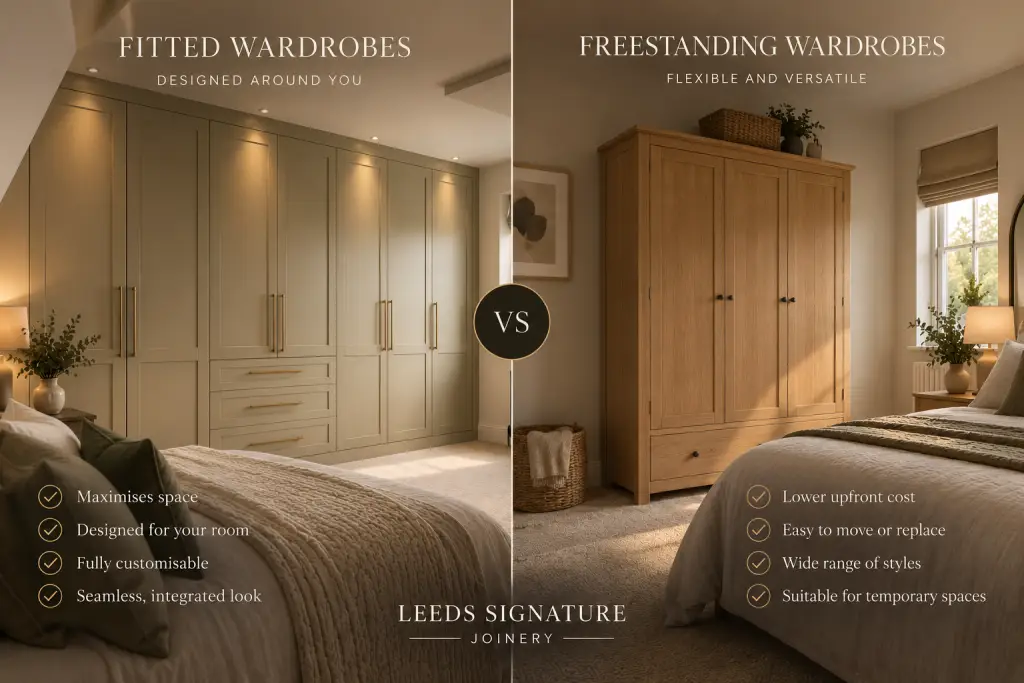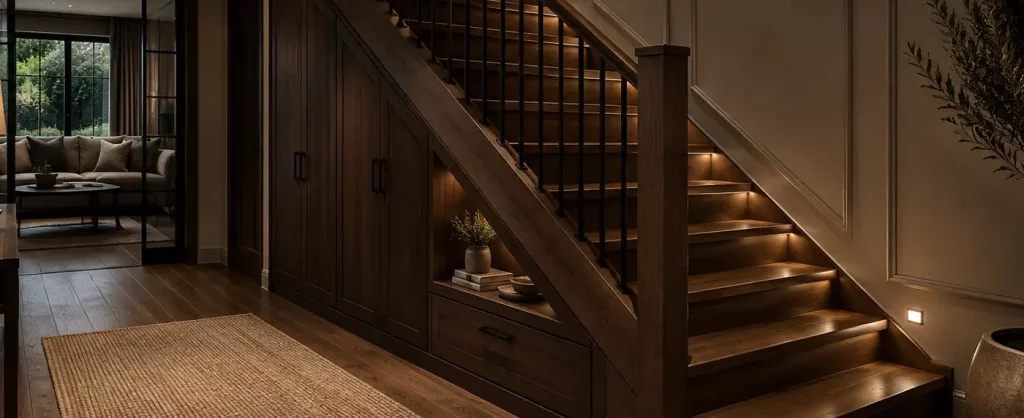
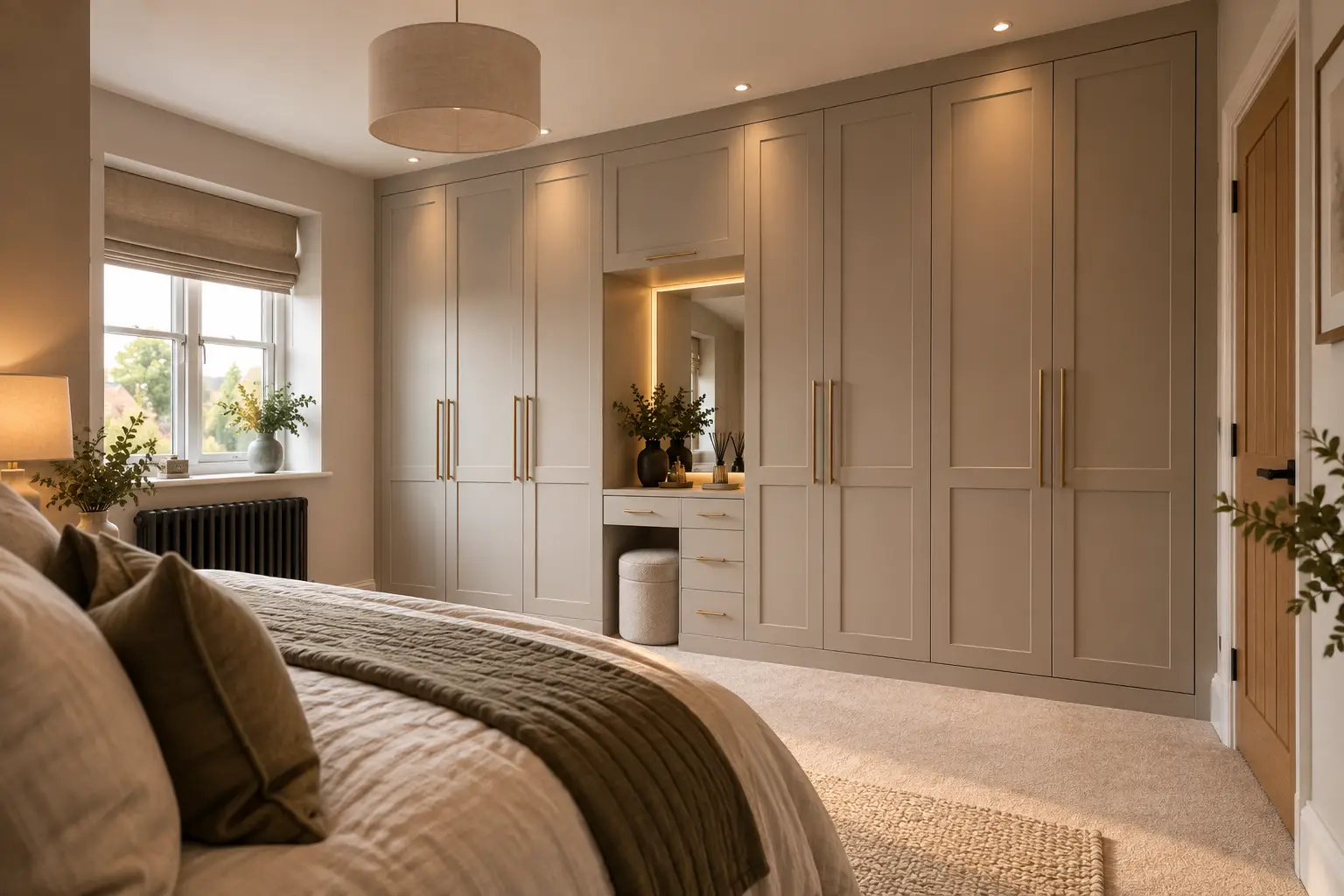
Fitted wardrobes are one of the most effective ways to maximise storage without compromising the appearance of a bedroom.
Unlike freestanding furniture, bespoke wardrobes can be designed around the exact dimensions of the room — using the full available height, fitting around alcoves, chimney breasts and sloping ceilings, and providing an internal layout designed specifically around what you need to store.
But how much should bespoke fitted wardrobes cost?
For most professionally designed and installed fitted wardrobe projects in Leeds, a realistic starting point is around £2,000–£3,000, with larger or more detailed installations commonly costing £3,500–£6,000+.
Premium finishes, extensive internal storage, specialist hardware and particularly large installations can take the cost considerably higher.
Here is what actually determines the price.
What Are Bespoke Fitted Wardrobes?
A genuinely bespoke fitted wardrobe is designed around the room rather than manufactured to predetermined standard dimensions.
That means we can control virtually every part of the installation, including:
- overall width and height
- wardrobe depth
- number and width of doors
- shelving positions
- hanging space
- internal drawers
- shoe storage
- adjustable shelving
- handles
- hinges and runners
- lighting
- decorative details
- materials and finishes
This flexibility is particularly valuable in rooms where standard furniture leaves significant areas of unused space.
Typical Fitted Wardrobe Costs in Leeds
There is no meaningful single price per wardrobe because the specification can vary enormously.
However, the following ranges provide a useful starting point when budgeting for professionally made fitted furniture.
Small Fitted Wardrobe: £2,000–£3,000+
A relatively simple fitted wardrobe across a smaller section of wall might include:
- two or three doors
- hanging rails
- basic internal shelving
- painted or decorative-board finish
- standard quality hardware
Keeping the internal configuration relatively simple helps control the cost.
Full-Wall Fitted Wardrobes: £3,000–£5,000+
A larger installation spanning most or all of a bedroom wall will naturally require considerably more material and manufacturing time.
The design may incorporate several wardrobe sections with a combination of hanging rails, shelves and drawers.
Taking the cabinetry close to ceiling height can also provide significantly more storage than standard freestanding wardrobes.
Premium Bespoke Wardrobes: £4,000–£7,000+
More detailed installations can include:
- spray-finished doors
- shaker-style cabinetry
- premium hinges and drawer runners
- integrated drawers
- oak or timber detailing
- specialist handles
- internal lighting
- decorative end panels
- cornices or shadow gaps
- more complex internal layouts
At this level, the wardrobes become an architectural feature of the room rather than simply somewhere to store clothes.
Large Dressing Rooms and Complex Installations: £6,000+
Walk-in wardrobes and large dressing-room installations can involve significantly more cabinetry.
These projects may combine open storage, wardrobes, drawers, shelving, dressing tables and specialist accessories within one coordinated design.
The final price depends almost entirely on the size and specification.
What Affects the Cost of Fitted Wardrobes?
Several factors have a much greater effect on price than others.
Understanding them makes it easier to decide where your budget is best spent.
Size
The overall size of the installation is an obvious factor.
A four-metre wall of cabinetry requires considerably more material and labour than a two-metre alcove wardrobe.
Height matters too.
Floor-to-ceiling wardrobes provide excellent storage but require additional material and can involve more complicated installation and finishing.
Number of Doors
Door construction is a substantial part of both the material and manufacturing cost.
A wardrobe with six individually manufactured shaker doors will generally require more work than a simpler four-door design covering the same approximate area.
The type of door also matters.
Plain slab doors are relatively straightforward, while detailed shaker or traditionally moulded doors require additional machining and finishing.
Internal Layout
The outside of two wardrobes can look virtually identical while the cost of the interiors differs considerably.
A simple interior containing shelves and hanging rails is relatively economical.
Adding multiple drawer boxes, pull-out storage and specialist accessories increases both material and hardware costs.
This is why we prefer to design the inside of the wardrobe around what the client actually needs rather than filling it with features simply because they are available.
Drawers
Drawers are one of the most useful additions to fitted furniture, but they also add significantly more work than a shelf.
Each drawer requires a box, front, runners and accurate installation.
Premium soft-close runners cost more than basic hardware but can make a substantial difference to how the finished furniture feels in everyday use.
Materials
There are several ways to manufacture fitted wardrobes.
Depending on the design, these may include:
- MDF
- moisture-resistant MDF
- veneered boards
- decorative furniture boards
- plywood
- solid timber
- combinations of several materials
There is no single material that is correct for every component.
A good wardrobe specification uses the appropriate material for each part of the furniture.
Painted vs Decorative Board Wardrobes
Both can produce excellent results, but they create very different finishes.
Painted wardrobes
Painted cabinetry provides enormous flexibility because virtually any suitable colour can be selected.
It works particularly well with shaker doors and more traditional fitted furniture.
A high-quality spray finish requires substantial preparation and finishing work, which is reflected in the cost.
Decorative board wardrobes
Modern decorative furniture boards are available in a huge range of colours, textures and wood effects.
They can create exceptionally clean contemporary interiors and often require less finishing after manufacture.
They are particularly useful for internal cabinetry where a durable, consistent surface is desirable.
The two approaches can also be combined.
For example, a wardrobe could have a durable decorative-board interior with bespoke painted doors and external panels.
Shaker vs Flat Wardrobe Doors
Door style has a major influence on the character of fitted furniture.
Shaker doors
Shaker-style doors provide additional depth and detailing.
They work particularly well in traditional, transitional and contemporary-classic interiors.
The proportions of the rails and stiles are important. Poorly proportioned shaker doors can make an otherwise good installation look heavy.
Flat doors
Flat or slab doors create a cleaner and more minimal appearance.
They work particularly well in contemporary bedrooms and can be combined with discreet handles or handleless detailing.
Because the design is simpler, attention to alignment and consistent gaps becomes particularly important.
Are Bespoke Wardrobes More Expensive Than Modular Systems?
Usually.
A modular wardrobe system benefits from mass production and standardised dimensions.
Bespoke furniture involves considerably more individual work, including surveying, design, material preparation, manufacturing and installation.
However, price alone does not tell the whole story.
A standard wardrobe might leave unused areas above or beside the furniture. Bespoke cabinetry can use those areas as functional storage.
The comparison is therefore not simply between two pieces of furniture of the same size.
One is selected to fit approximately within the available space; the other is designed specifically for it.
Can Fitted Wardrobes Go Right to the Ceiling?
Yes, and in many rooms we prefer them that way.
Taking fitted furniture to the ceiling can:
- maximise storage
- eliminate dust traps above wardrobes
- create a more integrated appearance
- make the furniture feel part of the architecture
- provide storage for less frequently used items
There are exceptions.
Very high ceilings, decorative cornices or particular design styles may make a lower installation more appropriate.
The proportions need to work with the room.
What About Uneven Walls and Floors?
This is one of the reasons professional fitting matters.
Homes are rarely perfectly square.
Walls can bow, floors can run out of level and ceilings can vary considerably across a room.
Bespoke furniture needs to accommodate those imperfections while appearing straight and intentional once installed.
This is normally achieved through careful surveying and the use of scribes, fillers, plinths and other finishing details.
The finished wardrobe should fit the room — rather than expecting the room to be perfectly square.
Can Fitted Wardrobes Work Around Chimney Breasts?
Absolutely.
Alcoves and chimney breasts are actually some of the best applications for bespoke furniture.
Instead of losing awkward areas of the room, cabinetry can be designed around the available dimensions.
Depending on the layout, this could involve wardrobes within alcoves, cabinetry spanning around a chimney breast or different depths across the installation.
What About Sloping Ceilings?
Bespoke wardrobes are particularly useful in loft conversions and rooms with sloping ceilings.
Standard furniture often leaves substantial unusable areas in these spaces.
Custom cabinetry can follow the available geometry and turn awkward areas into useful storage.
The design needs careful consideration because very low sections are not always suitable for conventional hanging space.
Those areas may work better for drawers, shelves or storage of less frequently used items.
How Long Do Bespoke Wardrobes Take to Install?
The site installation itself might take several days depending on the size and complexity of the project.
However, installation is only one part of the process.
A bespoke project can involve:
- initial consultation
- site survey
- design
- material selection
- manufacturing
- finishing
- installation
- final adjustment
Where painted components are being spray finished, much of that work should ideally happen away from the client’s home before installation.
This helps us achieve a more controlled finish while reducing disruption on site.
Is Bespoke Furniture Worth the Cost?
That depends on what you need from the room.
If a standard wardrobe fits perfectly and provides enough storage, bespoke cabinetry may not be necessary.
But where space is limited, the room has awkward dimensions or you want the furniture to become part of the overall interior design, fitted furniture offers significant advantages.
The biggest difference is often not simply appearance.
It is how efficiently the available space is used.
A well-designed wardrobe should make everyday storage easier while also improving the room visually.
How to Get the Best Value From Bespoke Wardrobes
More features do not automatically produce a better wardrobe.
We would prioritise the areas that affect everyday use.
Spend money on good hardware, sensible internal layouts and properly constructed doors before adding accessories that may rarely be used.
Think carefully about what you actually own.
How much long hanging space do you need? How many drawers? Do you fold most clothing? Do you need shoe storage? Could high-level cupboards hold seasonal items?
Those decisions allow the cabinetry to be designed around you rather than around a generic wardrobe layout.
Getting an Accurate Fitted Wardrobe Quote
To provide an accurate quotation, we normally need to understand:
- approximate dimensions
- ceiling height
- number of wardrobe sections
- preferred door style
- internal storage requirements
- material preferences
- colour and finish
- drawer requirements
- handles and hardware
- any lighting requirements
- unusual walls, ceilings or architectural features
Photographs and approximate dimensions can be useful for an initial discussion.
A proper site survey can then establish the dimensions required for manufacture.
Bespoke Fitted Wardrobes in Leeds
At Leeds Signature Joinery, we design, manufacture and install bespoke fitted furniture throughout Leeds and the surrounding areas.
With two decades of joinery experience, our focus is not simply on filling a wall with cupboards. We consider how the furniture fits the architecture of the room, how the internal storage will actually be used and how every visible detail contributes to the finished result.
From simple fitted wardrobes to full-wall bedroom furniture and complete dressing rooms, each installation is designed around the individual property and client.
If you’re considering fitted wardrobes for your home, contact Leeds Signature Joinery to discuss your ideas, dimensions and the options available.