
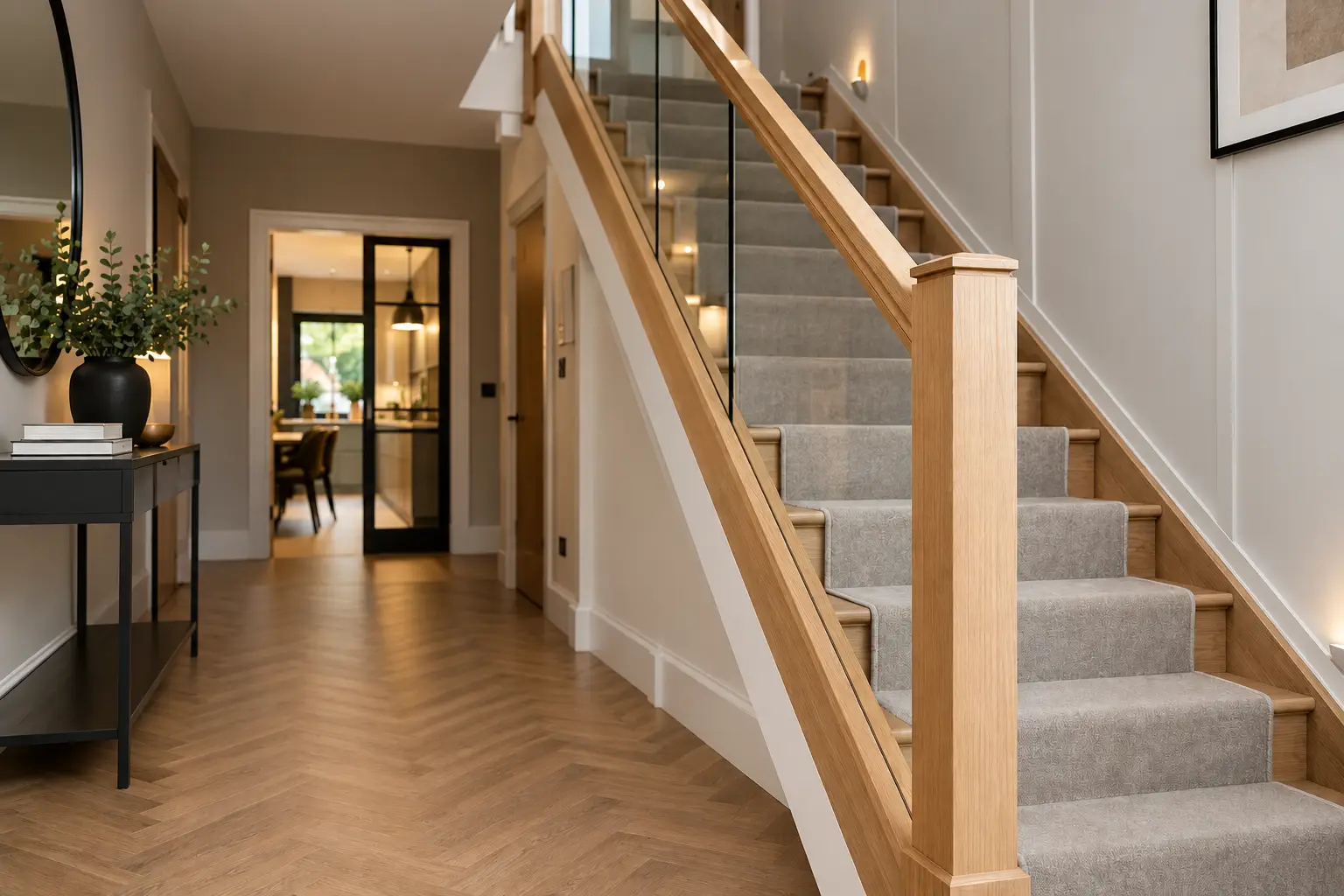
A staircase is one of the most prominent features in many homes. It is often one of the first things you see when entering the property, yet it is also an area that can become dated surprisingly quickly.
The good news is that achieving a completely different look does not necessarily mean replacing the entire staircase.
A staircase renovation can retain the existing structural flight while replacing or upgrading visible components such as the handrails, newel posts, spindles, baserails and stair cladding. Depending on the design, the result can look and feel like an entirely new staircase.
But how much should you expect a staircase renovation to cost in Leeds?
There is no single price because staircase designs, materials and the amount of work involved vary considerably. As a general guide, a straightforward balustrade renovation might start from around £1,500–£2,500, while more substantial oak, glass or fully clad staircase transformations can run to £4,000–£8,000+.
Here is what determines the final cost.
What Is Included in a Staircase Renovation?
A staircase renovation can range from replacing a dated handrail and spindles to transforming virtually every visible part of the staircase.
Typical work can include:
- replacing handrails and baserails
- replacing timber or metal spindles
- installing glass balustrades
- replacing or modifying newel posts
- fitting new newel post caps
- cladding existing newel posts in oak
- cladding stair strings
- fitting oak treads and risers over an existing staircase
- replacing or upgrading landing balustrades
- removing dated decorative components
- repairing damaged timber
- adding finishing trims and mouldings
- preparing the staircase for painting, staining or oiling
The right approach depends on the condition of the existing staircase and the appearance you want to achieve.
In many properties, the underlying staircase is perfectly serviceable. Renovating the visible components can therefore provide a dramatic transformation without the disruption and expense associated with removing the complete flight.
Typical Staircase Renovation Costs in Leeds
Every staircase needs to be assessed individually, but the following figures provide a useful starting point.
Basic Balustrade Renovation: £1,500–£2,500+
A relatively straightforward renovation might involve replacing the existing handrail, baserail and spindles while retaining most of the original staircase.
This can be particularly effective where the existing staircase is structurally sound but the balustrade looks dated.
The final price will depend heavily on the length of the balustrade, number of newel posts and materials selected.
Oak Staircase and Balustrade Renovation: £2,500–£5,000+
Introducing oak can completely change the character of a staircase.
A typical project might include oak handrails, baserails, newel components and new spindles, while the existing staircase structure remains in place.
More complicated staircase layouts, longer landing balustrades and extensive newel alterations will increase the cost.
Oak and Glass Staircase Renovation: £3,000–£6,000+
Glass balustrades are popular in contemporary staircase renovations because they create a clean appearance while allowing light to travel through the hallway and landing.
A typical design may combine:
- solid oak handrails
- oak newel posts or newel cladding
- toughened glass panels
- oak baserails or suitable glass fixing systems
Glass normally requires accurate surveying and fabrication, making precise installation particularly important.
Full Staircase Transformation: £4,000–£8,000+
For a much larger transformation, the staircase can be renovated beyond the balustrade.
This could include oak tread and riser cladding, string cladding, new newel components and a completely new balustrade.
At this level, most of the visible staircase can be transformed while retaining the underlying structural flight.
Large or particularly complex staircases can exceed these figures.
What Affects the Cost of a Staircase Renovation?
Two staircases that initially look similar can require very different amounts of work.
Several factors have a particularly significant effect on price.
The Size and Layout of the Staircase
A straight staircase with a short landing balustrade will generally cost less to renovate than a staircase with several flights, turns and extensive landing areas.
More balustrade means more handrail, baserail, spindles or glass.
Features such as half-landings, galleries and multiple newel posts can also increase both material requirements and installation time.
The Materials You Choose
Material selection is one of the biggest variables.
Paint-grade softwood can provide an attractive result at a relatively modest cost, whereas extensive use of solid oak will increase the material cost.
Glass introduces another price consideration because panels often need to be manufactured specifically for the staircase.
Premium hardware, metal spindles and specialist finishes can also affect the overall budget.
Oak vs Painted Timber
You do not necessarily need to manufacture every component from oak to achieve a premium finish.
One particularly effective approach is combining natural oak with painted timber.
For example, a staircase might use an oak handrail and newel caps alongside painted newel posts and spindles.
The oak creates warmth and a high-quality focal point, while the painted components provide contrast.
It can also be considerably more cost-effective than using oak throughout the entire staircase.
Glass vs Spindles
Choosing between glass and traditional spindles is largely an aesthetic decision, although there are practical and cost considerations too.
Glass works particularly well in contemporary interiors and can make hallways feel more open.
Timber spindles provide considerably more design flexibility. Traditional turned spindles can suit period properties, while simple square profiles can produce a much more contemporary appearance.
Metal spindles are another option and can work especially well alongside oak handrails and newel posts.
There is no universally better option. The best solution is the one that complements the architecture and interior design of the property.
Can You Renovate a Staircase Without Replacing It?
Very often, yes.
This is one of the biggest advantages of staircase renovation.
Many existing staircases have a perfectly sound structural flight underneath dated finishes. Removing the entire staircase would therefore add significant work without necessarily providing much benefit.
Instead, we can often work with the existing structure and replace the components that determine how the staircase actually looks.
This can include the balustrade, newel details, stair coverings and decorative timberwork.
The result can be a staircase that appears completely different without removing the original flight.
Can Existing Newel Posts Be Reused?
In many cases they can.
Existing structural newel posts are often integral to the staircase and do not automatically need to be removed.
Depending on their condition and dimensions, they may be:
- reshaped
- cut down and adapted
- clad in oak
- fitted with new newel sections
- finished with new caps
Retaining suitable existing structural components can reduce unnecessary disruption while still allowing a substantial visual transformation.
Can an Existing Staircase Be Clad in Oak?
Yes. Oak staircase cladding is an excellent option when the existing flight is structurally sound but you want the appearance of an oak staircase.
New oak components can be fitted over selected parts of the existing staircase, including treads, risers, strings and newel posts.
The detailing is important.
Poorly fitted staircase cladding can look like material has simply been added over an existing staircase. A good renovation should appear intentional, with clean junctions, consistent margins and carefully considered transitions between components.
Is Staircase Renovation Cheaper Than a New Staircase?
Usually, but not always.
If the existing staircase is structurally sound and the layout is staying the same, renovation can avoid much of the work involved in removing and replacing the complete staircase.
A completely new staircase becomes more appropriate when:
- the existing flight is structurally defective
- the staircase layout needs changing
- the rise or going needs significant alteration
- the opening is being repositioned
- major structural alterations are already being undertaken
For purely aesthetic transformations, renovation is often the more practical approach.
How Long Does a Staircase Renovation Take?
A straightforward balustrade replacement may take only a few days.
More extensive projects involving oak cladding, glass and substantial alterations can take considerably longer.
There may also be separate stages for surveying, manufacturing and finishing.
We prefer to assess the staircase before providing a programme because the amount of site work can vary substantially between properties.
Should You Renovate the Staircase Before Decorating?
Ideally, yes.
Staircase renovation involves removing existing components, cutting and fitting new timber and potentially making alterations to adjacent walls or finishes.
Completing the joinery first allows decorators to finish neatly around the new staircase.
Where parts of the staircase are being painted, the sequence of joinery and decorating should be planned together to achieve the cleanest result.
Does a Staircase Renovation Add Value to a Home?
It is difficult to attribute a specific increase in property value to one improvement, but a staircase can have a significant impact on how a home presents.
Unlike furniture that can be replaced or moved, the staircase forms part of the architecture of the property.
A well-designed staircase can therefore change the impression created by the entire hallway and landing.
For us, that is one of the most important aspects of staircase design. It needs to function properly and be built correctly, but it should also feel like a feature of the home rather than simply a way of getting from one floor to another.
Getting an Accurate Staircase Renovation Quote
Online price guides are useful for establishing a budget, but an accurate quotation requires considerably more information.
We normally need to consider:
- staircase dimensions
- number of flights
- landing balustrade lengths
- existing newel posts
- condition of the current staircase
- chosen timber
- spindle or glass design
- tread and riser requirements
- finishing requirements
- access and installation complexity
Photographs are often enough for an initial conversation, followed by a site survey where required.
Staircase Renovations in Leeds
At Leeds Signature Joinery, we design and install bespoke staircase and balustrade renovations throughout Leeds and the surrounding areas.
With two decades of joinery experience, our focus is on the details that make a staircase feel properly considered: accurate joints, clean transitions, balanced proportions and materials that work with the rest of the property.
From replacing an outdated handrail and spindles to creating a complete oak and glass staircase transformation, each project is designed around the existing property rather than treated as a one-size-fits-all package.
If you are considering renovating your staircase, you can contact Leeds Signature Joinery to discuss the design, materials and likely cost of your project.

