
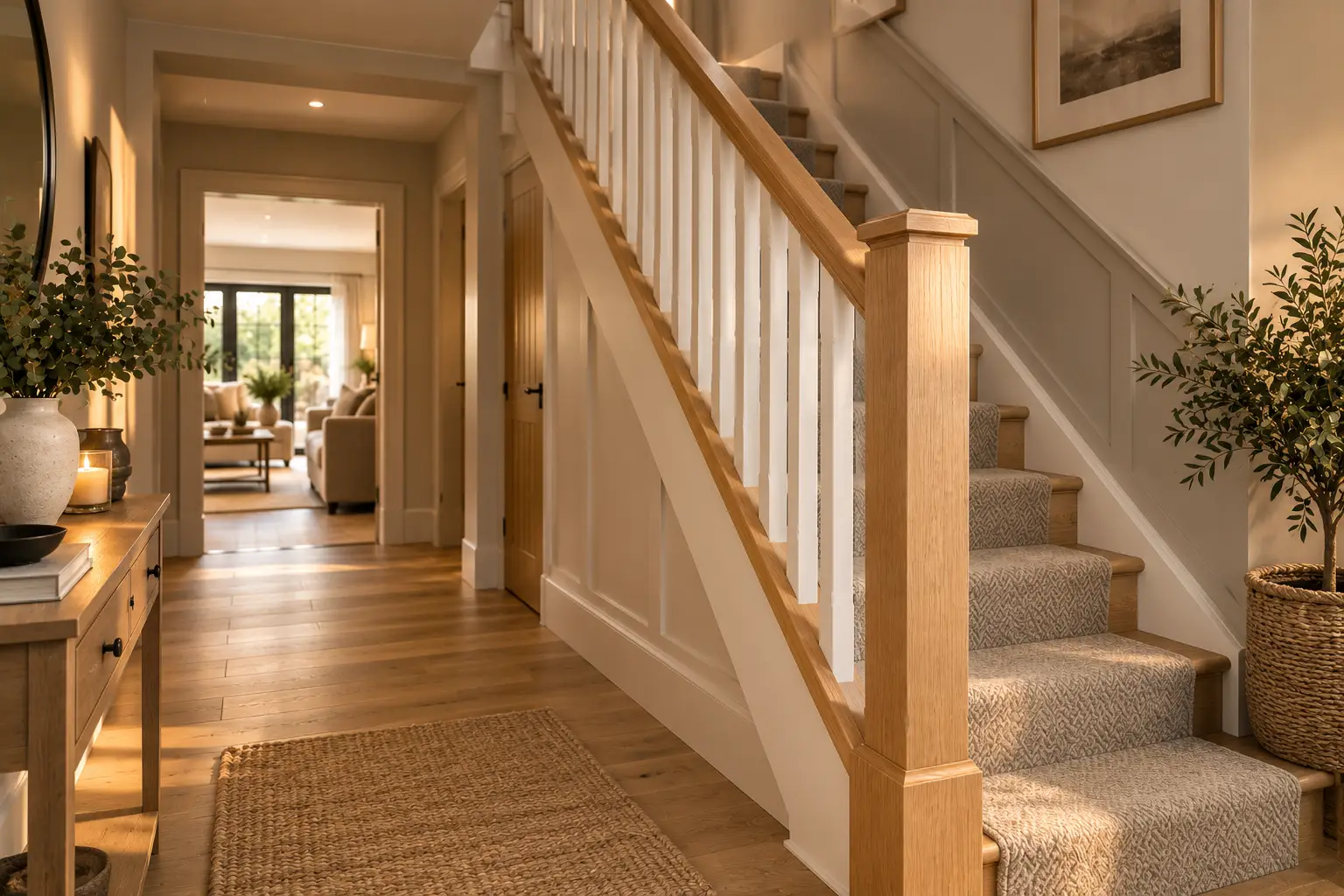
A staircase balustrade has a much bigger influence on the appearance of a home than many people realise.
The staircase itself may remain structurally unchanged for decades, but changing the handrail, newel posts, spindles or glass can completely transform the hallway. A traditional staircase can become contemporary, a dark hallway can feel considerably more open, and a relatively ordinary staircase can become one of the main features of the property.
Three of the most popular options are oak, glass and spindle-based balustrades. In practice, these are not always separate choices. Some of the best staircase designs combine them — for example, an oak handrail with glass panels or oak newel posts with black metal spindles.
So which option is right for your home?
What Is a Staircase Balustrade?
The balustrade is the protective barrier running alongside the open side of a staircase or landing.
It usually consists of several components:
- newel posts
- handrails
- baserails
- timber or metal spindles
- glass panels
- newel caps
- associated fixings and trims
These components have an important safety function, but they also form much of what you actually see when looking at a staircase.
That makes the balustrade one of the most effective areas to change when renovating an existing staircase.
Oak Staircase Balustrades
Oak remains one of our preferred materials for staircase renovations.
It has a natural warmth and character that works particularly well in a hallway, while its strength makes it well suited to components such as handrails, newel posts and baserails.
Oak can also work in both traditional and contemporary interiors.
The difference comes down to the design.
A traditional staircase might combine oak with turned timber spindles and detailed newel posts, whereas a contemporary staircase could use simple square newels, a clean-profile oak handrail and glass.
Advantages of Oak
Oak offers several benefits:
- durable and hard-wearing
- attractive natural grain
- works with traditional and contemporary designs
- can be combined with glass, timber or metal
- available in numerous profiles and details
- can be oiled, stained or finished to complement the interior
Because oak is a natural material, every piece has its own grain and character. For us, that variation is part of its appeal rather than something to hide.
Oak Doesn’t Mean Everything Has to Be Oak
One misconception with staircase renovations is that choosing oak means every component needs to be manufactured from solid oak.
It doesn’t.
Some of the most effective designs deliberately combine materials.
For example:
Oak handrail + painted spindles + painted newels
can provide a premium finish without the expense or visual weight of using oak everywhere.
Likewise:
Oak handrail + oak newels + glass
creates a very different, more contemporary result.
This gives us considerable flexibility when designing a staircase around both the property and the available budget.
Glass Staircase Balustrades
Glass is one of the most effective ways to modernise an existing staircase.
Rather than having numerous vertical spindles interrupting the view, glass panels create larger uninterrupted areas.
This can make the staircase appear cleaner and visually lighter.
It can be particularly effective in hallways where maintaining natural light is important.
Does Glass Make a Hallway Feel Bigger?
It can.
Glass obviously does not physically increase the size of the hallway, but reducing the number of solid visual elements around the staircase can make the space feel more open.
Light can pass through the balustrade and the eye can see beyond it rather than stopping at a row of spindles.
This is particularly noticeable where a staircase sits prominently within an entrance hall or open-plan living area.
Does a Glass Balustrade Need a Handrail?
The exact construction depends on the balustrade system and design.
Glass can be incorporated in several different ways, including panels fitted between timber newel posts, glass secured into a baserail and handrail system, or more minimal specialist fixing arrangements.
For residential staircase renovations, we often prefer designs where the glass is integrated with substantial timber components.
An oak handrail above clear glass, for example, provides the visual lightness of glass while retaining the warmth and tactile quality of natural timber.
Whatever the design, the completed balustrade must be properly specified and installed for its location.
Is Glass Difficult to Keep Clean?
Glass will naturally show fingerprints and dust more readily than painted timber spindles.
For many homeowners, however, cleaning is relatively straightforward because the surfaces are flat and accessible.
Whether that trade-off is worthwhile depends on the household and the desired appearance.
If extremely low maintenance is the priority, traditional spindles may be preferable.
If openness and a contemporary appearance are more important, glass can be an excellent choice.
Timber Spindles
Timber spindles are the traditional solution, but that does not mean a spindle staircase needs to look traditional.
The profile makes an enormous difference.
Decorative turned spindles can complement period properties, while simple square or slim-profile spindles can create a considerably more contemporary appearance.
They can also be painted to contrast with an oak handrail.
A particularly effective combination is:
natural oak handrail + white painted spindles
The oak becomes the feature while the painted components visually blend with the surrounding interior.
Metal Spindles
Metal spindles provide another option between traditional timber and completely open glass.
Black metal in particular works well with oak.
The contrast between warm natural timber and dark metal can create a distinctive contemporary or industrial-influenced staircase without making the balustrade entirely transparent.
Metal spindles are also available in numerous profiles, from very simple straight designs to twisted and decorative patterns.
The important thing is choosing a design that suits the property rather than selecting components individually.
Glass vs Timber Spindles
Neither is universally better.
The choice largely comes down to the effect you want to achieve.
Glass may be better if you want:
- a contemporary appearance
- maximum visual openness
- fewer interruptions to sightlines
- more light travelling through the staircase
- the staircase to become a prominent design feature
Timber spindles may be better if you want:
- a traditional or transitional appearance
- greater choice of decorative profiles
- painted finishes
- straightforward future refinishing
- a more understated balustrade
There is also nothing preventing the two approaches from being used elsewhere in the same project where the design requires it.
What About Metal Spindles?
Metal is worth considering if you like the definition created by spindles but want something more contemporary than traditional timber.
Black metal combined with oak is particularly effective.
It can provide more visual detail than glass while remaining relatively slim and unobtrusive.
For certain interiors, it also creates a stronger architectural feature than either painted timber or transparent glass.
Which Balustrade Is Most Expensive?
Cost depends heavily on the actual specification.
Glass is not automatically the most expensive option, and timber spindles are not automatically the cheapest.
The price is influenced by:
- balustrade length
- number of newel posts
- staircase configuration
- timber species
- spindle design
- glass dimensions
- fixing system
- alterations to the existing staircase
- finishing requirements
- installation complexity
A simple oak and glass installation could therefore cost less than a highly detailed staircase containing numerous bespoke timber components.
For a broader breakdown of likely budgets, see our guide to how much a staircase renovation costs in Leeds.
Should You Keep the Existing Newel Posts?
Often, yes.
If existing newel posts are structurally sound, they may be incorporated into the new staircase design.
Depending on the desired appearance, we may be able to modify them, clad them in oak or adapt them to accept new components.
Removing structural newel posts unnecessarily can introduce considerably more work.
The better approach is to assess what is already there and determine which elements genuinely need replacing.
Matching the Staircase to the Rest of the Home
This is one of the most important parts of staircase design.
A staircase should not look as though it has been selected independently from everything around it.
We consider features such as:
- flooring
- internal doors
- wall colours
- existing timber
- furniture
- architectural style
- natural light
- surrounding metalwork
If a home already contains oak flooring and black-framed doors, for example, an oak and black metal balustrade may tie those elements together.
In another property, clear glass and pale oak might be much more appropriate.
The goal is not simply to create an attractive staircase. It is to create one that looks like it belongs in the property.
Traditional Property or Modern Property?
The age of the house should influence the design, but it does not necessarily dictate it.
A period property does not always require a traditional staircase, just as a modern house does not automatically require glass.
Contrast can work extremely well when it is deliberate.
However, proportions and detailing become especially important when mixing styles.
A very minimal balustrade inserted into a highly decorative period hallway can look disconnected if the surrounding architecture has not been considered.
Likewise, an elaborate traditional spindle design may feel unnecessarily heavy in a minimalist contemporary interior.
Safety Should Come Before Appearance
A staircase balustrade is not simply decorative joinery.
It is a guarding system designed to help prevent falls from stairs and landings.
Dimensions, openings, fixing methods and the suitability of components therefore need to be considered as part of the design.
This is particularly important when altering an existing staircase because the new components need to work correctly with the existing structure.
A beautiful balustrade that has been poorly designed or inadequately fixed is not a successful staircase renovation.
Choosing the Right Staircase Balustrade
For most homeowners, we would not start by asking:
“Do you want glass or spindles?”
We would start with the property.
What does the existing staircase look like? What materials are already present? How much natural light does the hallway receive? Which parts of the staircase can be retained? And what do you want the finished space to feel like?
From there, the appropriate combination of oak, glass, timber or metal becomes much easier to determine.
Sometimes the answer is a full oak and glass transformation.
Sometimes replacing a dated handrail and spindles is enough to completely change the staircase.
Good staircase renovation is less about using the most expensive materials and more about using the right materials in the right proportions.
Bespoke Staircase Renovations in Leeds
At Leeds Signature Joinery, we design and install staircase and balustrade renovations throughout Leeds and the surrounding areas.
With two decades of joinery experience, we can work with existing staircases to create anything from a carefully considered balustrade upgrade to a complete staircase transformation using oak, glass, timber and metal components.
Every staircase is different, so we design around the property rather than trying to make the property fit a standard package.
If you’re considering renovating your staircase, contact Leeds Signature Joinery to discuss the design, materials and options available for your home.

