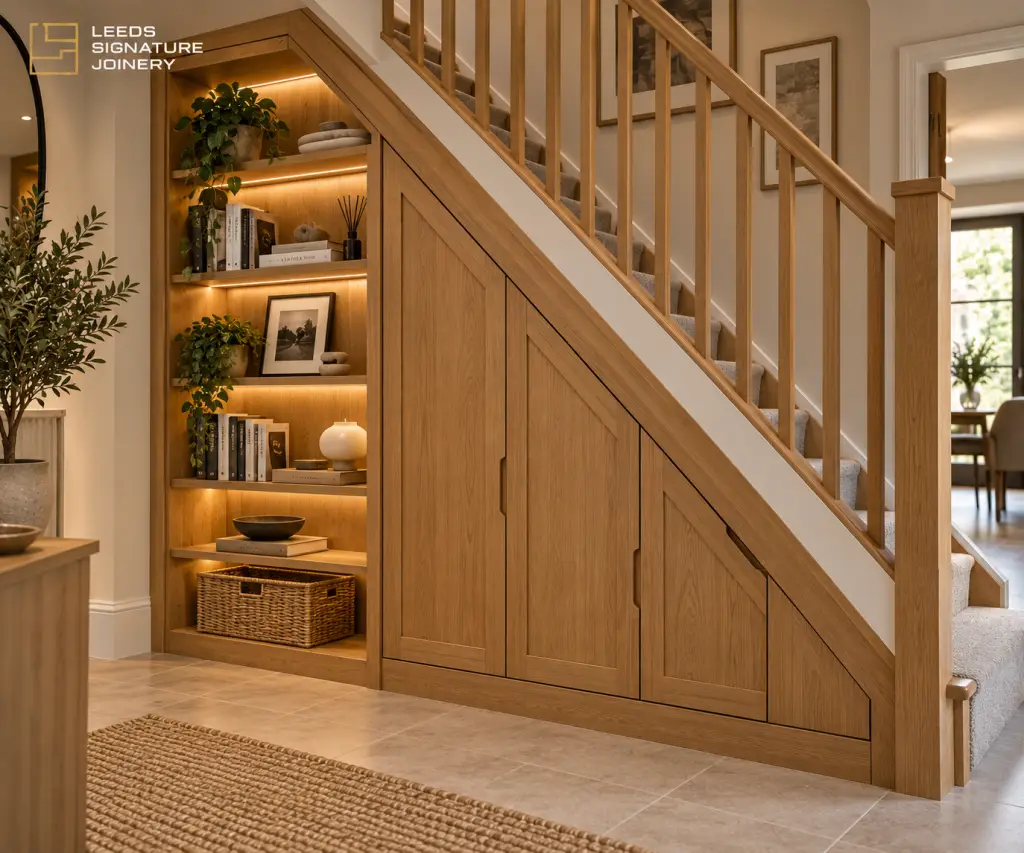
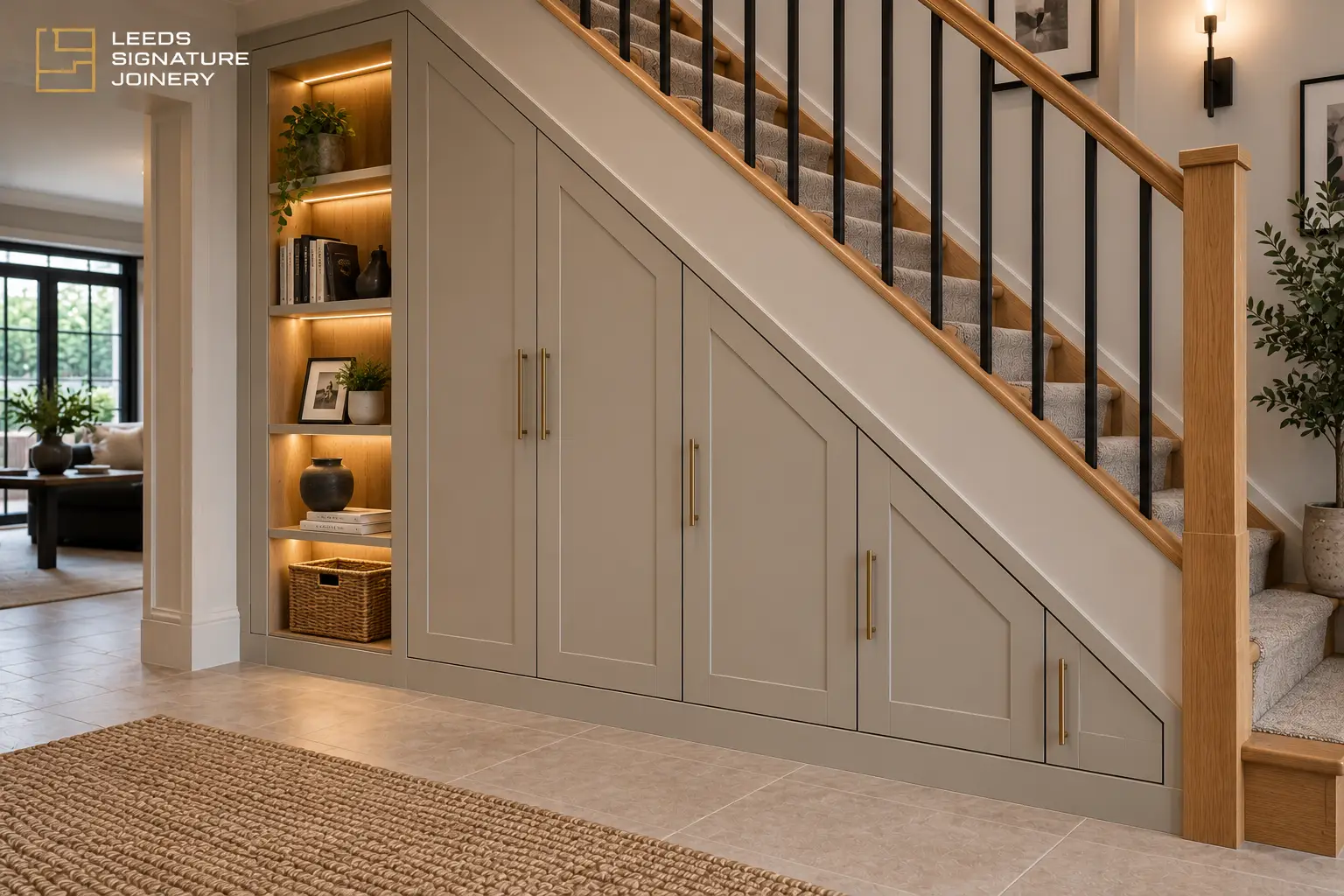
The space underneath a staircase is often one of the most underused areas of a home.
In many properties, it becomes an awkward cupboard filled with coats, shoes and household items. In others, the space is left completely unused.
A well-designed bespoke under-stairs storage system can transform that area into practical fitted storage while making it look like an intentional part of the interior.
But how much does bespoke under-stairs storage actually cost in Leeds?
The answer depends heavily on the design. A straightforward fitted cupboard is very different from a completely bespoke installation containing large pull-out drawers, individual shoe drawers, shelving and spray-finished cabinetry.
In this guide, we’ll explain the typical costs involved and what affects the price of professionally fitted under-stairs storage.
How Much Does Under-Stairs Storage Cost in Leeds?
As a broad guide, professionally made and installed bespoke under-stairs storage will often cost approximately:
- £1,200–£2,500+ for a relatively simple cupboard-based installation
- £2,500–£3,500+ for a combination of cupboards and pull-out storage
- £3,500–£5,000+ for larger or more complex bespoke installations with multiple drawers, premium finishes and detailed internal storage
Highly customised installations can cost more.
These figures should only be treated as general guidance. Under-stairs storage is usually designed and manufactured specifically for the individual staircase, so the final cost depends on the dimensions, layout, materials, hardware and finish.
Why Does Bespoke Under-Stairs Storage Vary So Much in Price?
Two installations may look relatively similar from the outside while being very different internally.
For example, one project might contain three simple hinged cupboards.
Another could contain:
- Three large pull-out drawers
- A tall coat cupboard
- Internal shelving
- Shoe storage
- Soft-close runners
- Push-to-open hardware
- Spray-finished fronts
The second installation requires considerably more manufacturing, hardware and installation work.
This is why the number of doors alone isn’t a particularly useful way to compare prices.
Pull-Out Drawers vs Cupboards
One of the biggest decisions is whether to use pull-out drawers, hinged cupboards or a combination of both.
Hinged Cupboards
Cupboards are generally the simplest solution.
Doors are fitted into the sloping area underneath the staircase, providing access to shelving or open storage behind them.
They’re particularly useful for:
- Coats
- Vacuum cleaners
- Cleaning equipment
- Larger household items
- General storage
Because the internal construction can be relatively straightforward, cupboard-based designs are usually at the lower end of the bespoke storage price range.
Pull-Out Storage
Pull-out units make much better use of deep spaces underneath a staircase.
Instead of reaching into the back of a cupboard, the entire storage unit can slide forward.
They work particularly well for:
- Shoes
- Bags
- Children’s belongings
- Household supplies
- Smaller everyday items
However, large pull-outs require considerably more construction than a conventional cupboard.
Each unit effectively becomes a piece of fitted furniture containing its own structure, drawer front and heavy-duty runners.
That additional work increases the cost.
A Combination Is Often the Best Solution
In many homes, we recommend combining the two.
The taller section underneath the staircase can become a cupboard for coats and larger items, while the lower sections can contain pull-out drawers.
This uses the changing height beneath the staircase efficiently.
For example, a typical arrangement might include:
Tall end: coat cupboard.
Middle: large pull-out storage.
Lower end: shoe drawers or smaller storage compartments.
The exact layout can be designed around what the household actually needs to store.
What Materials Are Used?
Material choice affects both appearance and cost.
A bespoke installation might be manufactured from:
- MDF
- Moisture-resistant MDF
- Furniture-grade plywood
- Veneered boards
- Solid timber
- Decorative furniture boards
- A combination of materials
For painted cabinetry, MDF is commonly used because it provides a smooth, stable surface for finishing.
Premium projects may incorporate oak or other timber details to coordinate with the staircase, flooring or surrounding joinery.
Shaker or Flat-Panel Doors?
The door style can significantly change the appearance of the finished installation.
Flat-Panel
Flat doors create a clean contemporary appearance.
They’re particularly effective where the intention is for the storage to blend quietly into the surrounding wall.
Shaker
Shaker-style fronts introduce more detail and create the appearance of traditional fitted furniture.
They work particularly well in period properties or interiors where other cabinetry already uses shaker detailing.
Because shaker fronts require additional machining and finishing, they can increase the manufacturing cost compared with simple flat doors.
How Much Do Drawer Runners Affect the Price?
Hardware is an important part of pull-out storage.
A large under-stairs drawer can carry a significant amount of weight, particularly when used for shoes, tools or household items.
Good-quality heavy-duty runners are therefore important.
Depending on the design, we may use:
- Soft-close runners
- Heavy-duty drawer runners
- Concealed runners
- Push-to-open systems
Higher-quality hardware costs more initially but can make a substantial difference to how the furniture feels and performs over time.
For something used every day, this is rarely an area where we’d recommend choosing the cheapest possible option.
Does the Finish Affect the Cost?
Yes.
There are several ways bespoke under-stairs furniture can be finished.
Ready for Painting
The cabinetry can sometimes be supplied ready for the client or decorator to finish.
This can reduce the overall cost.
Hand-Painted
Some installations are finished on site using appropriate furniture paints.
Spray-Finished
For a particularly smooth furniture-quality appearance, cabinetry can be professionally spray-finished.
Spray finishing requires additional preparation and finishing work, but produces a very clean result.
Colour can also be selected to complement the surrounding interior.
Can Under-Stairs Storage Match the Staircase?
Absolutely.
This is one of the advantages of having the storage designed specifically for the property.
Details can be coordinated with the staircase and surrounding joinery.
For example:
- Oak details can match an oak staircase.
- Shaker panels can match existing doors.
- Handles can coordinate with other ironmongery.
- Cabinet colours can match walls or kitchen cabinetry.
- Shadow gaps can create a more contemporary appearance.
The aim should be for the installation to feel like part of the room rather than furniture that has simply been placed underneath the staircase.
Can Under-Stairs Storage Be Handleless?
Yes.
Handleless designs are particularly popular in contemporary interiors.
Options can include:
- Push-to-open doors
- Push-to-open drawers
- Integrated finger pulls
- Recessed handles
- Discreet edge pulls
A handleless design can make the cabinetry visually quieter, particularly when the fronts are painted the same colour as the surrounding walls.
What Can You Store Under the Stairs?
One of the biggest advantages of bespoke furniture is that the internal layout can be designed around your requirements.
Common uses include:
- Shoe storage
- Coat storage
- Bags
- Children’s toys
- Cleaning equipment
- Vacuum cleaners
- Sports equipment
- Household supplies
- Wine storage
- Pet equipment
We’ve found that designing around what will actually be stored produces a much better result than simply dividing the space into arbitrary cupboards.
Shoe Storage
Shoes are one of the most popular uses for under-stairs storage.
Large pull-out drawers allow several rows of shoes to be stored while keeping them easily accessible.
Internal dividers or shelving can also be incorporated depending on the design.
This can be particularly useful in entrance halls where conventional shoe cabinets would otherwise take up valuable floor space.
Coat Storage
The taller section underneath the staircase is often ideal for coats.
Depending on the available height, this can include:
- Hanging rails
- Hooks
- Shelving above
- Shoe storage below
Combining this with pull-out storage further down the staircase can effectively create a compact fitted cloakroom.
Can You Add Lighting?
Yes.
Integrated lighting can be incorporated into some designs.
LED lighting can be useful inside deeper cupboards or display sections.
However, electrical work needs to be considered during the design stage so that cables, transformers and switching can be accommodated appropriately.
Where electrical installation is required, this should be carried out by a suitably qualified person where applicable.
What About Radiators, Consumer Units and Services?
The area beneath a staircase can sometimes contain existing services.
These might include:
- Electrical consumer units
- Pipework
- Radiators
- Meters
- Alarm equipment
- Network equipment
These don’t necessarily prevent bespoke storage from being installed.
Instead, the cabinetry can often be designed to provide appropriate access.
It’s important that equipment requiring inspection, maintenance or ventilation isn’t permanently enclosed without suitable provision.
Uneven Walls and Floors
Older homes in Leeds frequently have walls and floors that aren’t perfectly straight, square or level.
Bespoke fitted furniture can be scribed and adjusted to suit these conditions.
This is one of the major differences between genuinely fitted furniture and freestanding or modular units.
The visible finishing panels can be fitted closely to the surrounding walls, staircase and floor to create a much more integrated appearance.
How Long Does Under-Stairs Storage Take to Install?
The installation itself may take approximately one to several days, depending on the complexity of the project.
However, bespoke furniture usually involves considerably more work before installation.
The overall process can include:
- Site survey and measurements
- Design and layout
- Material preparation
- Workshop manufacturing
- Finishing or spray painting
- Site installation
- Final adjustments
More complicated projects containing several pull-outs and detailed finishing naturally require more manufacturing time.
Bespoke vs Off-the-Shelf Under-Stairs Storage
Modular storage can be a good solution where budget is the main consideration.
However, staircases rarely create perfectly standard spaces.
The angle, depth and height vary from property to property.
Bespoke storage allows the available space to be used much more effectively because the furniture is designed around the actual staircase.
It also allows the external appearance to coordinate properly with the surrounding interior.
Does Under-Stairs Storage Add Value to a Home?
It’s difficult to assign a specific monetary increase in property value to one piece of fitted furniture.
However, well-designed storage can make a home considerably more practical and visually appealing.
Storage is particularly valuable in properties where space is limited.
More importantly, bespoke under-stairs furniture converts an awkward area that often serves little purpose into usable storage without taking additional floor space from the room.
Is Bespoke Under-Stairs Storage Worth It?
For households struggling with hallway storage, it can be one of the most effective uses of otherwise wasted space.
The strongest designs combine three things:
Practical storage — everything has a purpose.
Efficient use of space — the full depth and shape beneath the staircase is utilised.
Good design — the cabinetry complements the staircase and surrounding room.
When all three are considered together, the finished installation can look as though it was always intended to be part of the property.
Getting an Under-Stairs Storage Quote in Leeds
For an initial quotation, useful information includes:
- Photographs of the staircase
- Approximate width of the staircase
- Approximate height at the tallest point
- Approximate depth
- What you would like to store
- Preferred door or drawer style
- Preferred finish
- Project location
From there, the design can be refined around the available space.
For bespoke installations, a detailed site survey is normally required before final manufacture.
Bespoke Under-Stairs Storage in Leeds
At Leeds Signature Joinery, we design, manufacture and install bespoke under-stairs storage for homes across Leeds and the surrounding areas.
Our installations can include:
- Pull-out drawers
- Shoe storage
- Fitted cupboards
- Coat storage
- Internal shelving
- Shaker-style cabinetry
- Contemporary flat-panel cabinetry
- Handleless storage
- Bespoke internal layouts
- Oak and timber detailing
With two decades of experience in carpentry and joinery, we approach under-stairs storage as fitted furniture rather than simply filling an empty space.
The aim is to create something that uses the available space intelligently, works properly every day and looks like an intentional part of your home.
If you’re considering bespoke under-stairs storage in Leeds, contact Leeds Signature Joinery to discuss your ideas and request a quotation.=