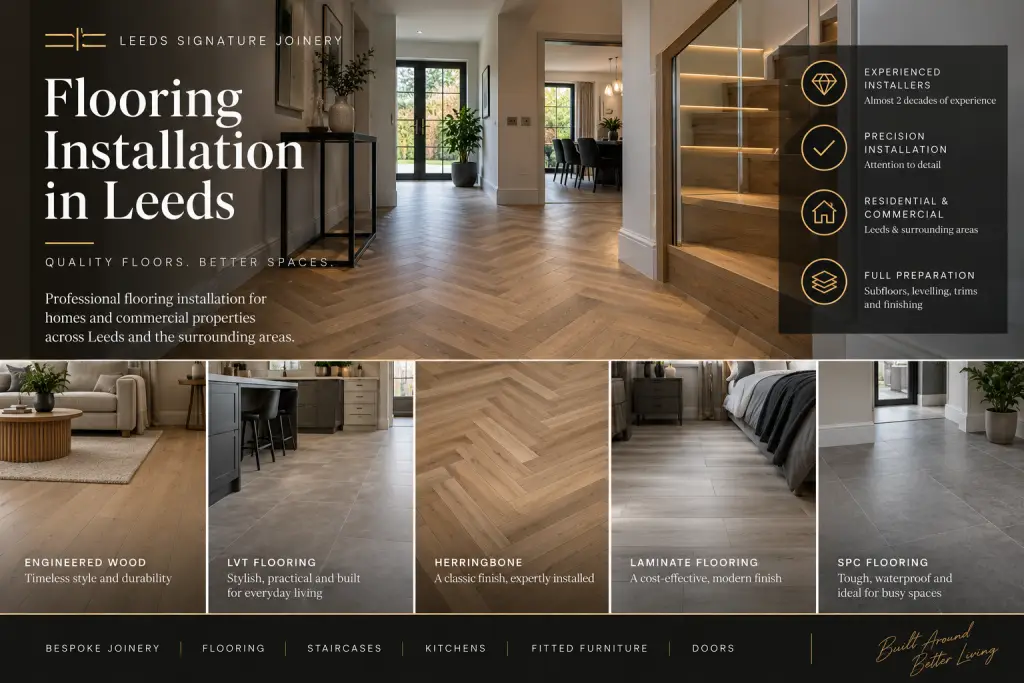

Choosing a new floor can become surprisingly complicated.
LVT, engineered wood and laminate can all create an attractive finished floor, but they are very different products in terms of construction, durability, moisture resistance, feel and cost.
There isn’t one flooring type that is best for every home.
For a busy kitchen, we may favour something completely different from what we would recommend for a living room where natural timber is an important part of the design.
The right choice comes down to where the flooring is being installed, how the room is used, the condition of the subfloor and the finish you want to achieve.
Here is how the three compare.
What Is LVT Flooring?
LVT stands for luxury vinyl tile.
Despite the name, it is available in both tile and plank formats and can replicate materials such as:
- oak
- walnut
- stone
- concrete
- ceramic tiles
Modern LVT can be extremely convincing, particularly with higher-quality products that combine detailed printing with textured surfaces.
There are several different types of LVT, including glue-down and click systems.
The correct installation method depends on the product and substrate.
What Is Engineered Wood Flooring?
Engineered wood flooring uses a genuine timber surface over a layered core.
Unlike solid timber flooring, the entire board is not manufactured from one piece of hardwood.
A quality engineered oak floor still gives you the appearance and character of real oak because the visible surface actually is real timber.
The layered construction provides greater dimensional stability than a traditional solid timber board.
This makes engineered flooring an attractive option where you want genuine wood but require a modern flooring system.
What Is Laminate Flooring?
Laminate flooring uses a manufactured core with a decorative surface designed to replicate timber, stone or another material.
Unlike engineered flooring, the visible surface is not genuine hardwood.
Modern premium laminate is considerably more sophisticated than many older products.
High-quality boards can have realistic grain textures, bevelled edges and excellent durability.
It is generally one of the most cost-effective ways to achieve a timber-style floor.
LVT vs Engineered Wood vs Laminate: Quick Comparison
| LVT | Engineered Wood | Laminate | |
|---|---|---|---|
| Real timber surface | No | Yes | No |
| Moisture resistance | Excellent on suitable products | Moderate | Product dependent |
| Durability | Excellent | Very good | Very good |
| Natural variation | Low | Excellent | Low |
| Maintenance | Easy | Moderate | Easy |
| Typical cost | Mid-range | Higher | Lower |
| Underfloor heating | Often suitable | Often suitable | Often suitable |
| Repair/refinishing potential | Limited | Product dependent | Limited |
| Best feature | Practicality | Natural timber | Value |
Always check the individual manufacturer’s specification rather than relying purely on flooring type.
Which Flooring Looks Best?
This is subjective, but engineered wood has one significant advantage:
it is actually timber.
Real oak has natural variation in colour, grain and figuring that manufactured surfaces attempt to reproduce.
No two boards are exactly identical.
For premium interiors where natural materials are an important part of the design, engineered timber is difficult to beat.
However, high-quality LVT and laminate can look extremely convincing.
The gap between inexpensive and premium products within each flooring category can be enormous.
We would therefore avoid judging a complete flooring type based on the cheapest examples available.
Which Flooring Is Best for a Kitchen?
For many kitchens, LVT is an excellent choice.
It combines:
- good durability
- easy cleaning
- strong moisture resistance
- extensive design choice
- relatively low maintenance
These characteristics suit an area where spills and regular cleaning are inevitable.
SPC and other rigid vinyl flooring systems can provide similar practical benefits depending on the product.
Engineered timber can also work in kitchens, but standing water and repeated moisture exposure require more consideration because the surface is genuine wood.
Which Is Best for a Living Room?
This is where engineered wood becomes particularly attractive.
A living room generally experiences less moisture than a kitchen or bathroom, making natural timber easier to accommodate.
Oak flooring can add warmth and character that works especially well alongside other joinery.
It can complement:
- oak staircases
- internal doors
- fitted furniture
- timber shelving
- architectural joinery
LVT and laminate remain perfectly viable alternatives where practicality or budget is the priority.
Which Flooring Is Best for Bedrooms?
All three can work well.
Bedrooms generally experience relatively light traffic and limited moisture.
The decision is therefore more likely to come down to:
- appearance
- feel
- budget
- acoustic performance
- existing subfloor
- underfloor heating
Laminate can offer excellent value in bedrooms.
Engineered timber provides a more premium natural finish.
LVT can work particularly well where the same floor continues through several rooms.
Which Flooring Is Best for Hallways?
Hallways experience considerably more traffic than many other areas of the home.
Outdoor footwear brings in dirt, grit and moisture.
Durability therefore becomes particularly important.
LVT is a strong option here because it is hard-wearing and relatively easy to maintain.
A quality engineered timber floor can also perform well, but it requires more consideration around maintenance and protection.
Which Is Most Waterproof?
LVT generally provides the strongest moisture resistance of these three categories, although the exact performance depends on the product and installation.
Some laminate products are marketed as highly water resistant, but this does not mean every laminate floor is waterproof.
Engineered timber contains genuine wood and therefore needs greater care around moisture.
The manufacturer’s instructions should always determine whether a particular product is suitable for bathrooms, kitchens and other potentially wet areas.
Which Is Most Durable?
There is no simple winner because product quality matters enormously.
A premium laminate may outperform a poor-quality LVT product.
Likewise, a properly maintained engineered timber floor can remain attractive for many years.
For busy households, good-quality LVT is particularly attractive because of its combination of durability and relatively simple maintenance.
Engineered wood will develop natural signs of use over time.
Some homeowners see this as character.
Others prefer a surface that remains more visually consistent.
Which Is Easiest to Maintain?
LVT is generally very straightforward.
Routine vacuuming and appropriate cleaning are usually sufficient.
Laminate is similarly easy to maintain, although excessive moisture should be avoided unless the product is specifically designed for it.
Engineered wood requires slightly more care.
Because the surface is real timber, suitable cleaning products and methods should be used.
Can Engineered Wood Be Sanded?
Some engineered timber flooring can be refinished.
The key factor is the thickness of the real timber wear layer.
A substantial wear layer may permit sanding or refinishing during the life of the floor.
Very thin veneers provide much less scope.
If future refinishing is important, this should be considered when selecting the product rather than after the floor has been installed.
Which Flooring Feels Best Underfoot?
Engineered timber generally provides the most natural feel because its surface is genuine wood.
But installation method and underlay also influence how a floor feels.
Floating flooring can feel and sound different from flooring bonded directly to the substrate.
The underlying construction therefore matters almost as much as the visible product.
What About Underfloor Heating?
Many LVT, laminate and engineered timber products can be used with underfloor heating.
But never assume compatibility.
The individual flooring manufacturer should specify:
- whether the product is suitable
- maximum permitted surface temperatures
- installation method
- appropriate underlay or adhesive
- heating commissioning procedure
Engineered timber is generally preferable to traditional solid timber where underfloor heating is involved because its construction provides improved stability.
Glue-Down vs Floating Floors
This is another important distinction.
Floating installation
The flooring is connected to itself but is not permanently bonded to the substrate.
Many laminate, SPC and engineered floors use this method.
Advantages can include relatively fast installation and easier future removal.
Glue-down installation
The flooring is bonded directly to a prepared substrate.
This is common with certain LVT and engineered timber products.
It can create a very solid feel underfoot, but the preparation needs to be particularly good.
Any significant imperfections in the substrate can affect the finished floor.
Subfloor Preparation Matters More Than People Think
The best flooring in the world will not compensate for a bad substrate.
Before installation, we need to consider whether the existing floor is:
- flat
- stable
- dry
- clean
- structurally sound
- suitable for the flooring system
Preparation may involve:
- repairing floorboards
- securing movement
- installing plywood
- applying smoothing compound
- removing old adhesive
- addressing localised high or low areas
This work is not particularly exciting compared with choosing the finished flooring.
It is, however, one of the most important parts of the project.
Which Is Best for Uneven Floors?
None of them should simply be used to hide a substantially uneven substrate.
Rigid flooring can bridge very small imperfections, but excessive movement or variation can stress joints and create problems.
Thin glue-down products can reveal imperfections beneath the finished surface.
The correct solution is normally to prepare the subfloor to meet the requirements of the flooring being installed.
Which Is Best for Herringbone?
All three categories can potentially be available in herringbone formats.
The visual effect can be very different.
Engineered oak herringbone
Provides genuine timber variation and a premium natural finish.
LVT herringbone
Offers the pattern with excellent practicality and a broad range of colours.
Laminate herringbone
Can provide the herringbone appearance at a more accessible price point.
Whichever material is selected, accurate setting out is critical.
A herringbone floor that runs noticeably out of alignment with the room can look wrong regardless of how expensive the material was.
Which Is Cheapest?
Laminate is generally the least expensive of the three.
LVT usually occupies the middle of the market, although premium LVT can cost considerably more.
Quality engineered timber is typically more expensive because the product incorporates genuine hardwood.
But material price is only part of the overall project.
You also need to consider:
- preparation
- underlay
- adhesive
- installation
- trims
- skirting
- thresholds
- wastage
A cheaper flooring product requiring extensive preparation can result in a more expensive project than expected.
How Much Does Installation Cost?
As a broad Leeds guide:
Laminate: approximately £20–£30+ per m²
LVT: approximately £30–£45+ per m²
Engineered wood: approximately £35–£50+ per m²
Herringbone installations: approximately £45–£60+ per m²
These are indicative labour figures rather than quotations.
Preparation, room complexity and installation method can change the price substantially.
For a more detailed breakdown, see our guide to flooring installation costs in Leeds.
Which Flooring Adds the Most Value?
It is difficult to assign a specific property value increase to a flooring material.
However, genuine high-quality timber flooring can contribute significantly to the perceived quality of an interior.
That does not mean engineered wood is automatically the best financial decision.
In a rental property or extremely busy family home, the durability and maintenance advantages of LVT may provide better long-term value.
The flooring needs to suit the property and its use.
Our Preference
We don’t believe in recommending one material for every room.
For a premium living space where natural materials matter, we particularly like engineered oak.
For kitchens, busy hallways and properties where practicality is the priority, quality LVT or SPC can be extremely effective.
Where budget is more important, a good laminate can produce an excellent result without trying to pretend it is something it isn’t.
The specification should follow the room rather than the trend.
Choosing the Right Flooring for Your Home
Before choosing purely on appearance, ask:
Where is it being installed?
How much traffic will it receive?
Could it be exposed to moisture?
Is there underfloor heating?
What is underneath the existing floor?
How much maintenance are you prepared to accept?
Do you specifically want genuine timber?
Once those questions are answered, the choice usually becomes much easier.
Flooring Installation in Leeds
At Leeds Signature Joinery, we install LVT, SPC, laminate and engineered timber flooring throughout Leeds and the surrounding areas.
Our work can include the preparation surrounding the installation, including plywood overlays, floorboard repairs, subfloor preparation, skirting and finishing details.
With two decades of joinery experience, we pay particular attention to the elements that determine how the finished floor looks: preparation, setting out, transitions, thresholds and the relationship between the flooring and surrounding joinery.
If you’re deciding between LVT, engineered wood or laminate, contact Leeds Signature Joinery with details of your room and the products you’re considering, and we can help establish the most appropriate installation approach.